Why have artificial plants suddenly become “high-end”?
The old artificial plants were easy to spot: shiny leaves, every leaf identical, flat printed colour, visible joints, and fading within a year. Back then they were just a “no-watering substitute”.
That has changed. Artificial plants are going through a round of premiumisation, and buyers no longer ask only “does it look real?”; they judge texture, colour accuracy and UV resistance the way they would when choosing real flowers. Designers are treating them as part of the space, not as material to fill a corner.
This article uses three common types — faux olive tree, faux fern and faux schefflera — to break down where the premium price goes and what to check when buying.
Faux olive tree: silver-grey fine leaves and a twisted trunk
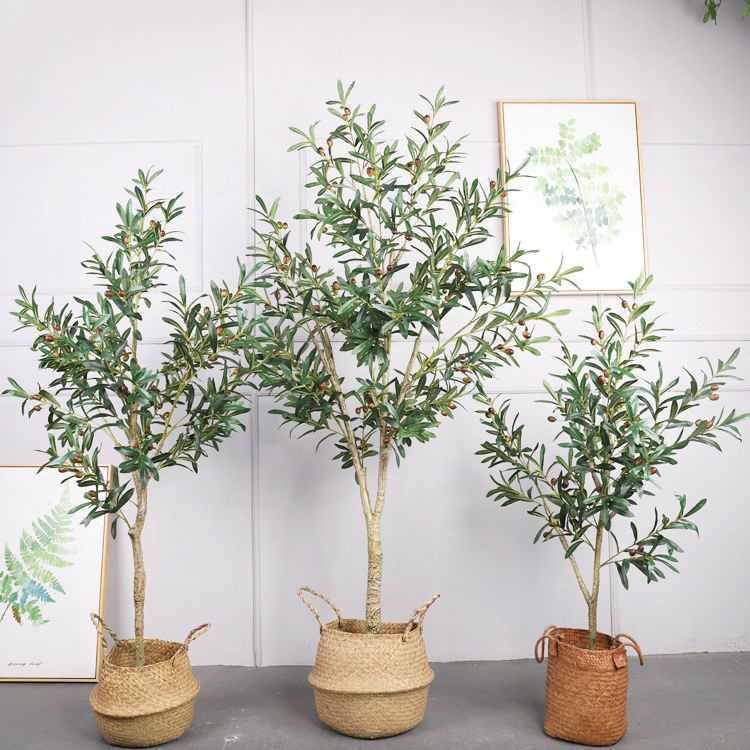
The olive tree is easy to recognise: narrow silver-green leaves, dark fruit and a twisted trunk. A good faux version can pass at a distance; a bad one turns into a “green feather duster”.
Four things to check when buying:
- Leaf shape and veins: the leaves should be narrow and pointed at both ends, with a clear midrib on the back; avoid versions with leaves that are too wide or too thick.
- Colour layers: silver-green is not one colour; the lit side leans silver and the shaded side is deeper. A tree that uses one colour throughout usually looks cheaper.
- Trunk and branches: the trunk should have vertical grain and natural twists; branches should not all point upwards with the same thickness.
- Fruit and proportion: do not use too many olives, or make them too large; the height of the tree should be in proportion to the pot, not top-heavy.
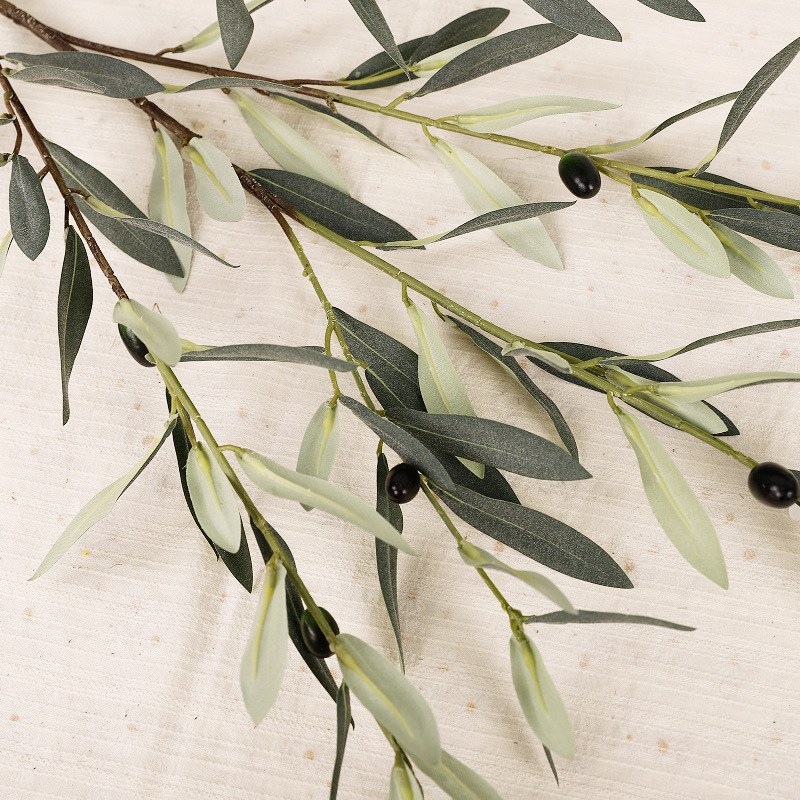
A faux olive tree suits an entrance, living room, terrace or office; if it goes outdoors or beside a west-facing window, make sure it is a UV-resistant outdoor grade, or the leaves will soon fade to grey.
Faux fern: the shadow and layers of feathery fronds
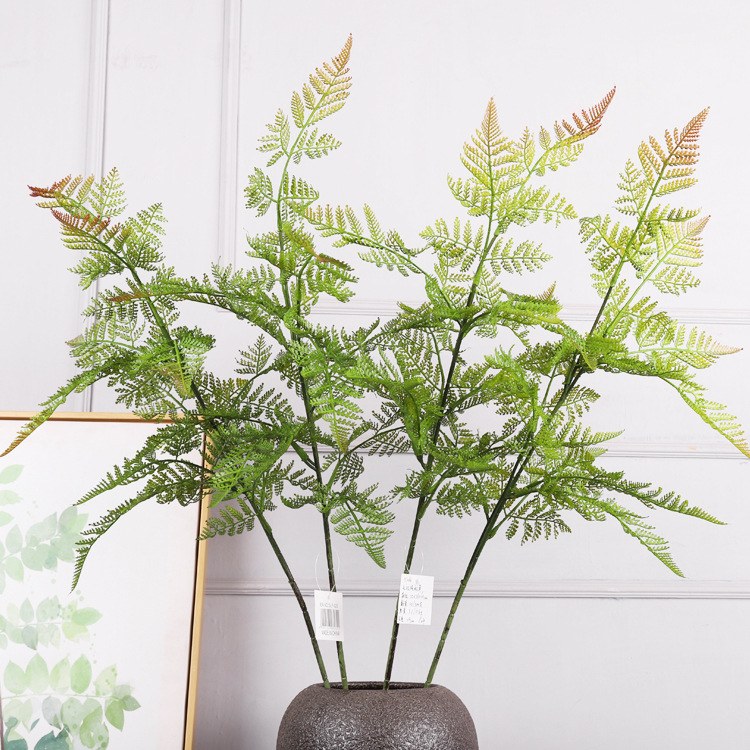
The difficulty with ferns is the “fragmentation”: one frond is made of dozens of leaflets. If a faux version uses too few leaflets and arranges them too neatly, it looks like a plastic saw blade. The premium approach is to vary the size and direction of the leaflets and add a little natural dryness at the tips.
Three things to check when buying:
- Leaflet density and direction: the leaflets should be dense, but not every one at the same angle; the frond stem should have a natural curve.
- Colour transition: from the stem to the tip, from new leaves to old, there should be a transition; a frond in one flat green usually looks fake.
- Leaf tips and dry edges: a little brown and dry at the edges is a plus, not a defect; but do not accept a frond that is scorched black all over.
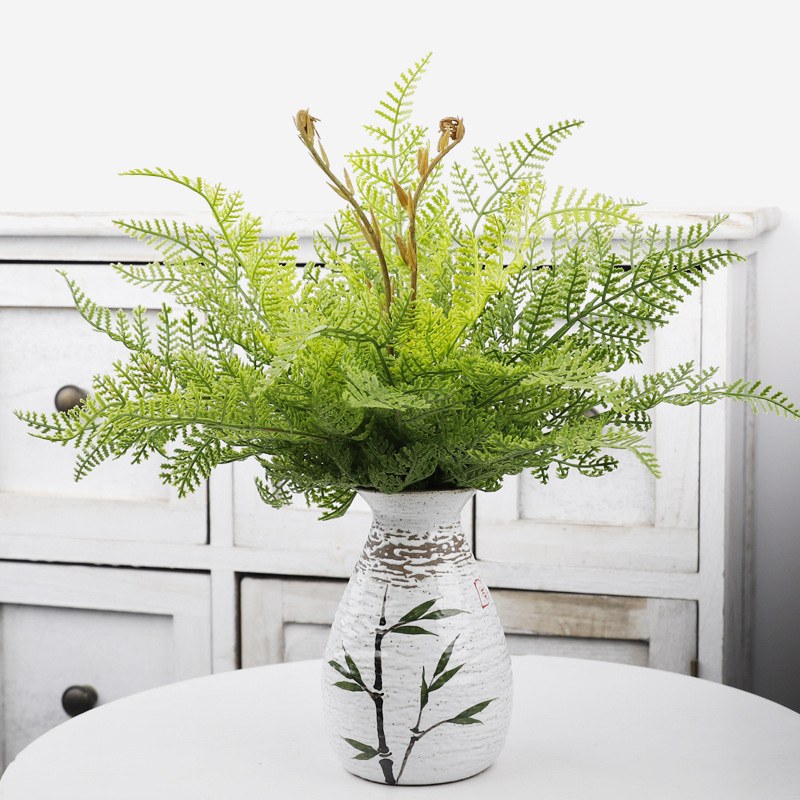
A faux fern suits a bathroom, an air-conditioned room, a low-light corner or an office shelf — places where a real fern is hard to keep long-term, while a faux version holds its shape. It still needs dusting; once the leaves are dusty, the texture drops noticeably.
Faux schefflera: rounded leaves and office spaces
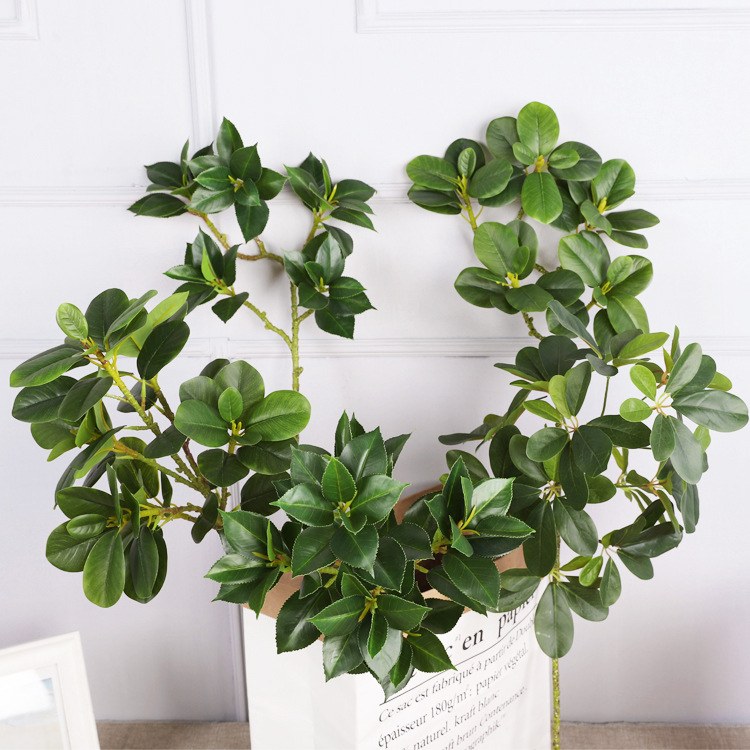
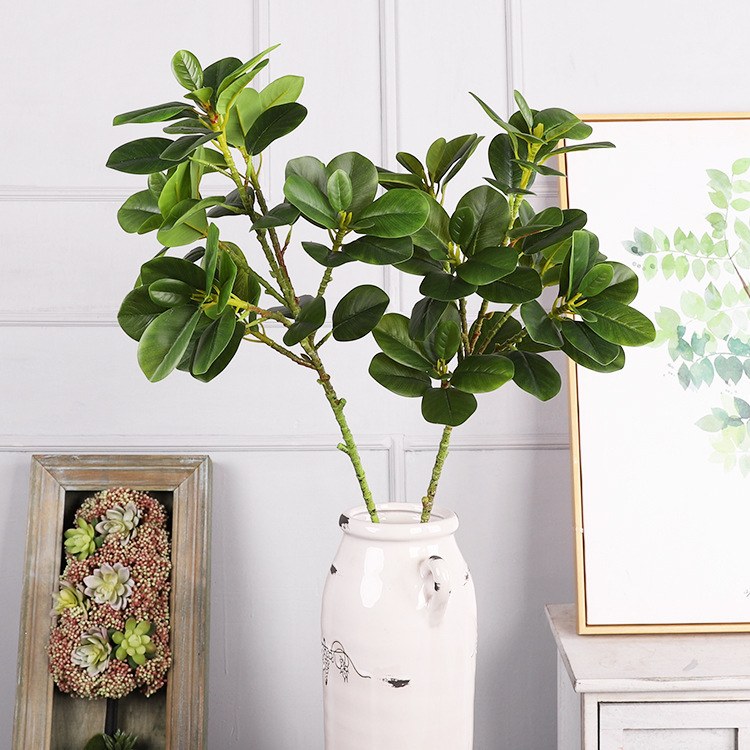
Schefflera leaves are palmate compounds: the leaflets spread out like an umbrella, with a glossy surface. The most common mistake in faux versions is making the leaflets too round, too thick and too shiny, so the whole plant looks like a plastic umbrella.
Three things to check when buying:
- Leaflet count and arrangement: usually seven to nine leaflets, of different lengths, spreading outwards; do not choose a version where every leaflet is the same size.
- Leaf gloss: real schefflera has a sheen, but not a plastic reflection; look at the sample from the side under a lamp — too much reflection is a source of cheapness.
- Stem joints: the joint between leaflet and stem should be clean; the stem should vary slightly in thickness, not stay perfectly smooth.
A faux schefflera suits an office, reception counter, meeting-room corner or shop entrance; it is more forgiving than an olive tree and easier to clean than a fern, one of the safest choices in a commercial space.
Choosing artificial plants like real flowers: five checks
1. Texture
Touch it, do not just look at the photo. The leaf should have thickness, raised veins and a matte surface; too smooth, too thin or too shiny usually means cheaper.
2. Colour accuracy
Put the sample in natural light and compare it with a real plant or a real photograph. Check three things: is there a gradient, is there a natural colour shift at the leaf edge, and is the green too fluorescent? Premium artificial plants use layered colouring, not a single dye.
3. UV resistance
For outdoors, a terrace or a west-facing window, choose a UV-resistant outdoor grade. UV resistance is not a permanent guarantee against fading, but it clearly extends the life; ask about the grade, care and warranty. An indoor grade placed outdoors will usually discolour within a year.
4. Structure and proportion
Check the wire in the leaves, the joints in the stem and the weight of the pot. A good artificial plant can be adjusted, but does not drop leaves at a touch; the proportion should be close to 1:1 — do not enlarge the leaves just to make it look bigger.
5. Safety and care
For commercial spaces, ask for fire-retardant treatment and low-odour materials; dust with a duster or a lightly damp cloth, and avoid alcohol and strong solvents. Artificial plants need no watering, but that does not mean no care — dust, deformation and fading all need attention.
Design-led: how to use artificial plants without looking cheap
The value of premium artificial plants is not only “no care”, but that designers can create a complete planting effect where there is no light, no water source and no one to look after plants long-term.
A few principles:
- Better one good one than ten cheap ones. A correctly proportioned faux olive tree has more presence than a row of small pots.
- Treat artificial plants as sculpture, placing them at an entrance, a corner or beside a counter, rather than stuffing one into every corner.
- Keep the quality consistent. Real and artificial plants can be mixed in one space, but the artificial ones must not look obviously one grade lower.
- Match the pot. Woven, concrete and ceramic pots affect the overall character; avoid pots that are too light or too shiny in plastic.
- Accept that it needs care. Dusting, shaping and avoiding long exposure to strong sun are what keep the high-end look.
In closing
Artificial plants are no longer a synonym for “cheap and no watering”. The core of premiumisation is texture, colour accuracy, UV resistance and design-led buying — buyers now choose artificial plants the way they choose real flowers, which is a good thing, because it will drive out the cheap products.
To see more artificial plants, or to create an entrance scheme for a shop, office or clubhouse, see the Artificial plants and Faux plants category, or see the Gardening services。
—
FAQ
Do artificial plants fade?
Yes, at a rate that depends on the UV grade and the sunlight. Indoors, avoiding long direct sun can keep them good for years; outdoors, choose a UV-resistant outdoor grade, and expect a shorter life than indoors.
Can they go outdoors?
Yes, but choose an outdoor-grade, UV-resistant material and avoid long periods of standing water or direct heavy rain. Standard indoor-grade artificial plants are not recommended for long-term outdoor use.
How do I clean artificial plants?
Dust with a duster or a lightly damp cloth; do not use alcohol, bleach or strong solvents. Dust makes the texture look worse, so commercial spaces should clean them regularly.
How do I choose between artificial and real plants?
For low light, places with no one to care for plants long-term, commercial spaces or temporary installations, artificial plants are more reliable; for life, real scent or air-purifying effects, choose real plants. The two can be mixed, but the quality should be consistent.