Entrance planting: why so many schemes end up looking messy
The entrance of a shop or clubhouse is the first thing a customer sees. Many projects start with the idea of making it "rich", so plants of different heights, colours and pots all go in at once. The focal points scatter, the building's facade is hidden, and the plants compete with each other; the result looks messy and cheap.
A planting border is not better because it has more flowers. The hard part of entrance design is restraint: what to keep, what to cut, and where to leave just one focal point.
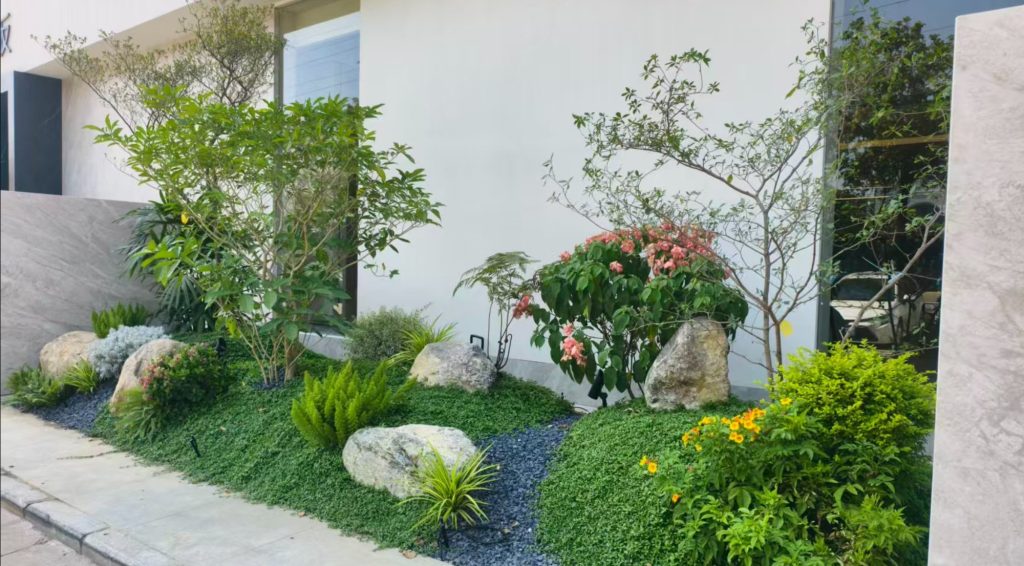
This scheme uses a simple white wall as its backdrop. It does not fill the space with flowers; it relies on three layers, contrasting materials and a small amount of colour to create a relaxed feel. The sections below break down the approach.
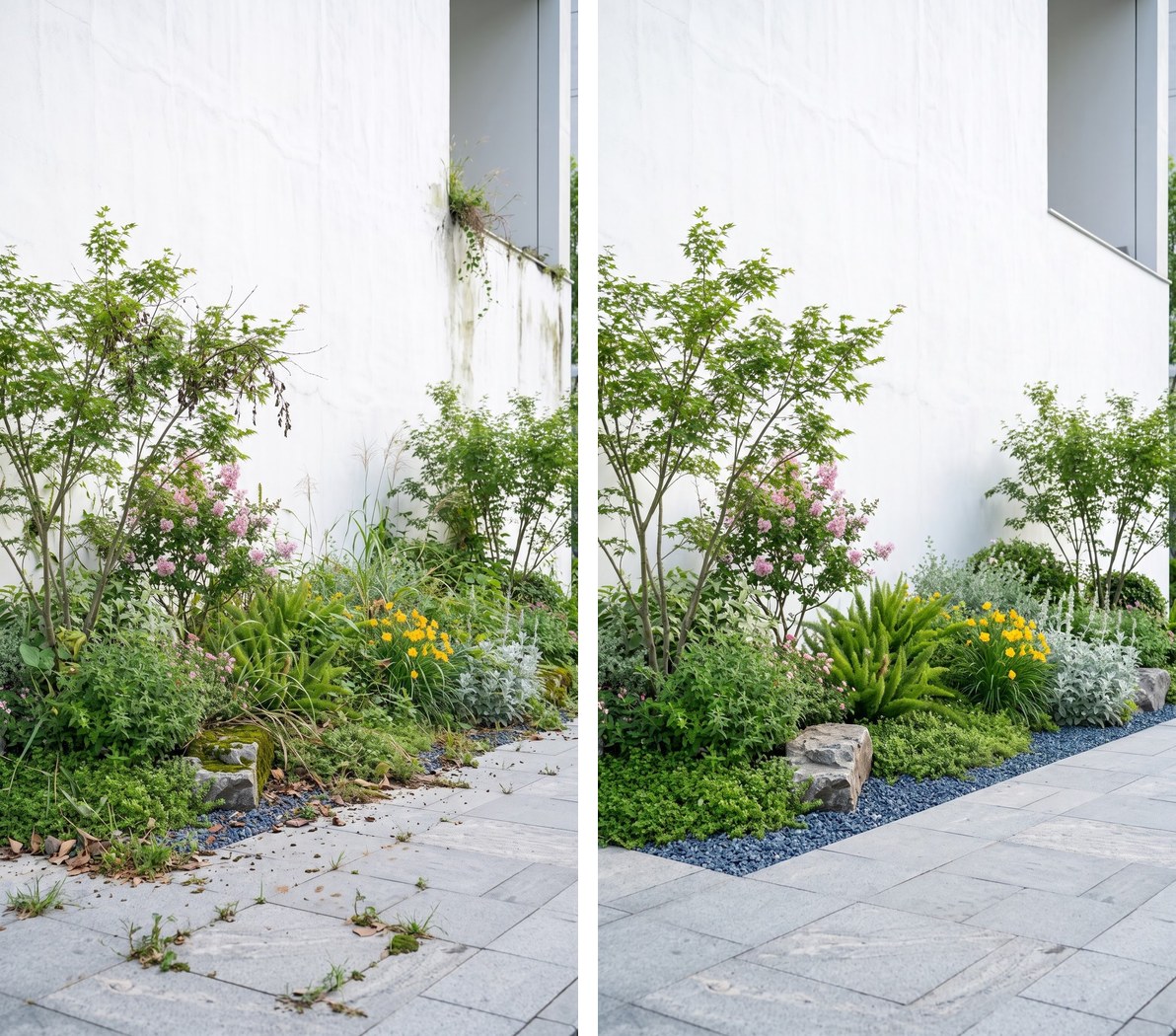
Three principles: less, layers, and fitting the building
- Less: fewer species, colours and focal points. An entrance is not a botanical garden; the eye can only hold one or two things at once.
- Layers: build the facade with upper, middle and ground layers, rather than placing every plant on the same level.
- Fit: the white wall, the entrance materials, signage, lighting and the route in all determine the plant selection and heights. The design should set off the building, not hide it.
- Space: leave breathing room between plants; the white wall is the backdrop, and the more space you leave, the clearer the layers read.
Upper layer: two light small trees to draw the vertical lines
The upper layer uses two small trees to set a frame. Their job is not to "fill the top", but to draw vertical lines and soften the hard edge of the white wall.
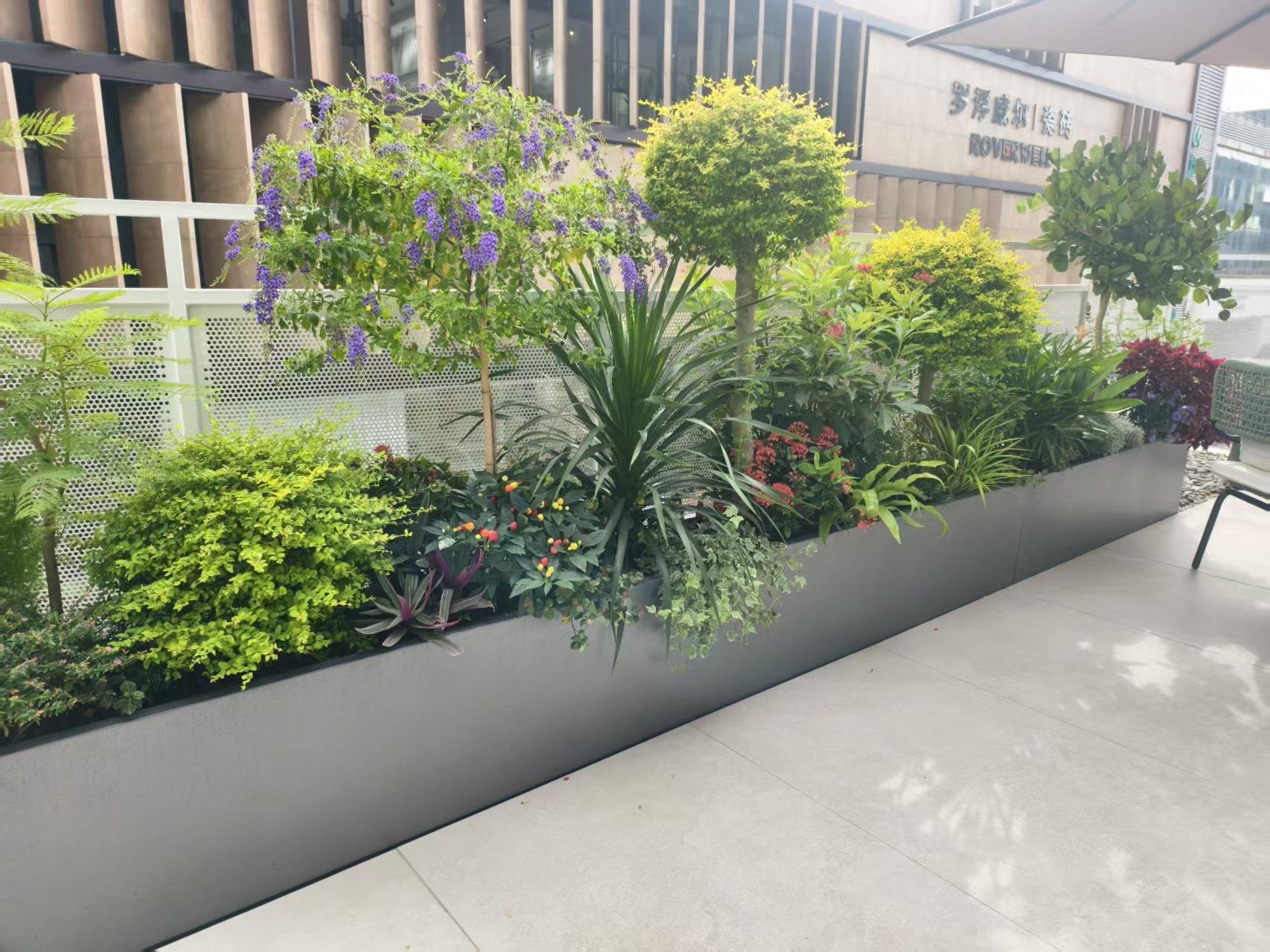
Choose an open canopy and light branching; avoid dense canopies and very large leaves, which make the entrance feel oppressive. The two trees do not need to be symmetrical: one taller, one lower, one forward, one back, for a naturally relaxed composition.
Keep the planting clear of signage, the entrance plaque, CCTV and fire access. Leave space between the canopy and the entrance, so there is room to prune later. Before Hong Kong's typhoon season, prune and secure the trees so branches cannot strike the building.
Middle layer: flowering plants and foxtail fern, with only one or two focal points
The middle layer is where the eye rests longest, and where it is easiest to add too much. This scheme uses a small amount of flowering plants for colour, paired with the radiating fronds of Asparagus densiflorus 'Myersii' for a contrast in texture.
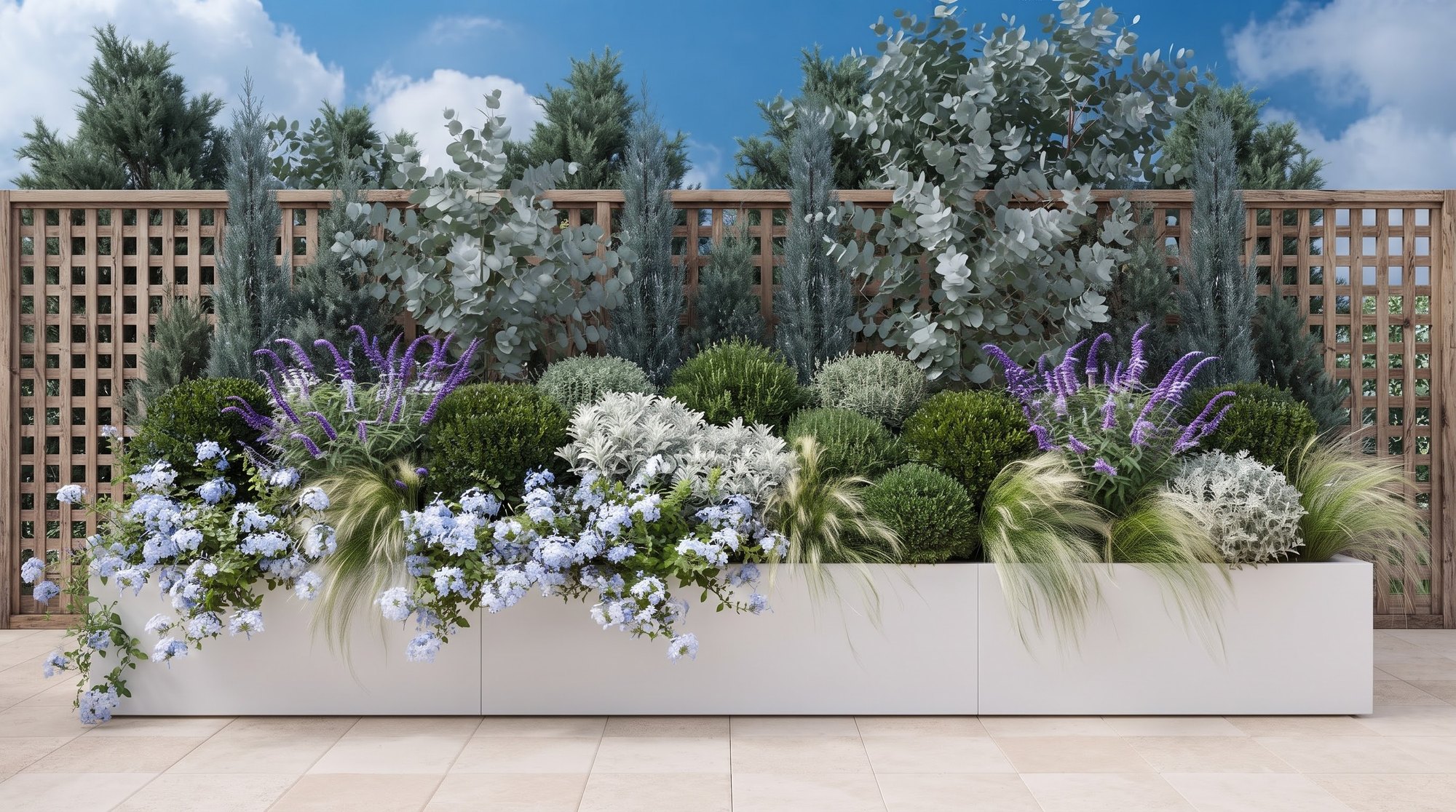
Choose low-saturation colours such as pink and yellow, and use them sparingly; one or two clumps are enough to give the eye somewhere to land. Foxtail fern likes partial sun to bright indirect light, and should be shaded from the midday sun in summer. Its strong lines break up the roundness of the flowering plants in the middle layer.
Keep the middle layer below the entrance signage, and do not repeat it in a row. Leave a little space between the flowering plants and the foxtail fern so the leaves and flowers each keep their outline.
If you want to choose plants directly, consider Bougainvillea and Ixora chinensis Lam for the middle layer, and Olive tree for the upper layer.
Ground layer: groundcover, feature stones and dark blue gravel for a soft-hard contrast
The ground layer uses a full cover of groundcover as a green base, edged with natural feature stones and dark blue gravel. This layer connects the "soft" planting with the "hard" building and paving.
- Groundcover: choose low, creeping, strongly covering species; a full cover reduces weeds and bare soil. Groundcover grows quickly and needs regular edge trimming, or it will creep out of the gravel band.
- Feature stones: one or two natural stones as the main feature, partly buried so they look like they grow out of the ground rather than being placed on top. Do not pile up too many stones, or it becomes clutter again.
- Dark blue gravel: use it as an edge along the planting bed, with the width set by the proportions of the site, typically around 15–25 cm. The dark blue makes a quiet contrast with green leaves and grey stone, and keeps the boundary neat.
- Soft against hard: the softness of the leaves, the weight of the stone and the grain of the gravel only create texture when they are placed together.
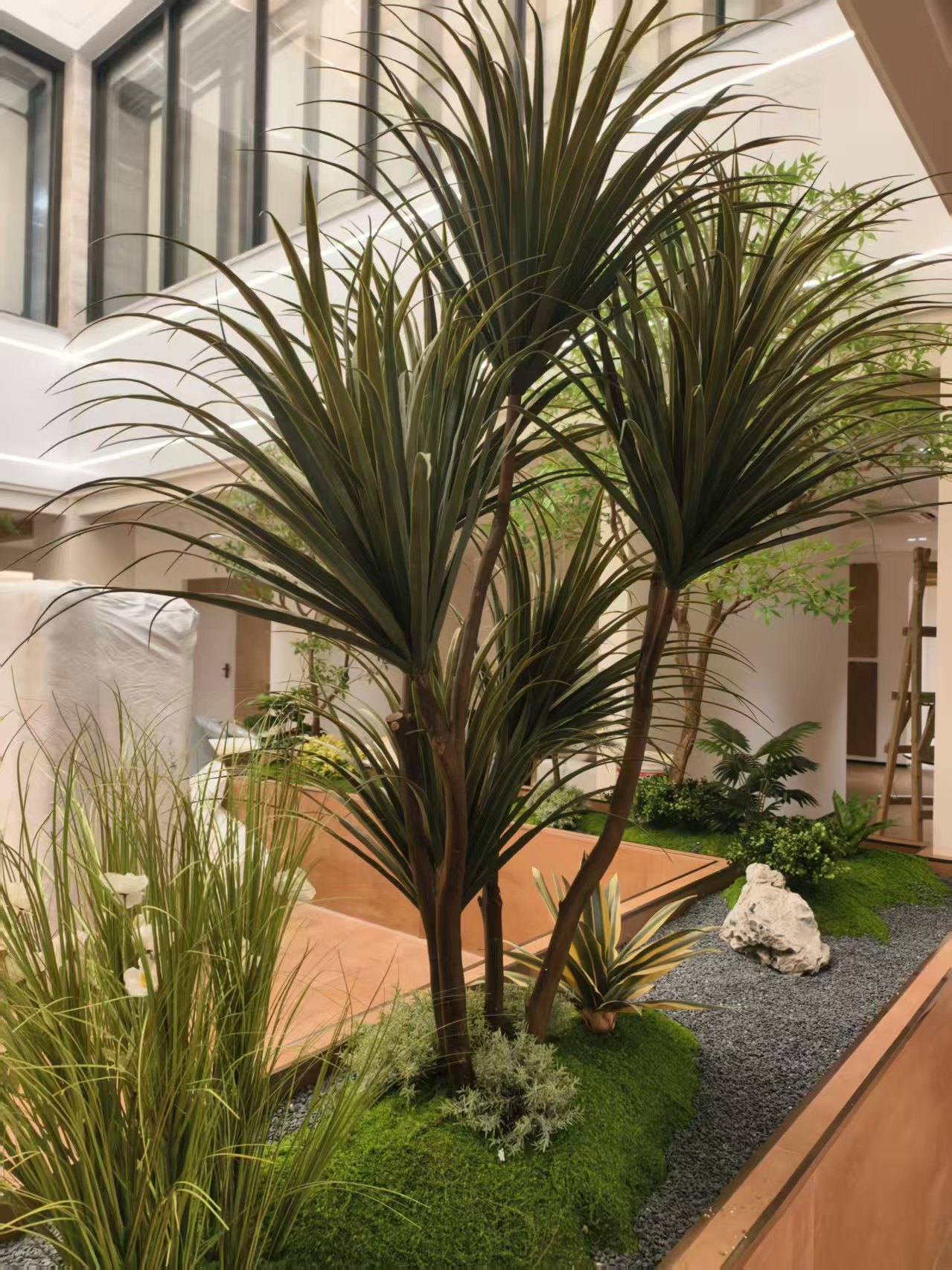
The gravel band also has to handle drainage and safe walking; do not use too fine a gravel, or it will blow away or stick to shoes. In leaf-fall season, a leaf blower keeps the lines tidier than a broom.
Colour: mostly layered greens, with pink and yellow as accents
Use layered greens as the base: dark green at the back, mid-green as a transition, and light or silver-green to lift it. Keep only a little pink and yellow in the flowers, so they set off the building quietly rather than competing with the signage and facade.
An entrance should not use more than three main colours. The fewer the colours, the more the layers and materials can be seen.
Species and maintenance: tough, humidity- and heat-tolerant
Outdoors in Hong Kong means heat, high humidity, heavy rain, typhoons and afternoon sun from the west. When choosing species, favour tough, humidity-tolerant, heat-tolerant and wind-resistant types. Rather than a plant that looks good for a season but is difficult to keep, choose one that holds its form over time.
Maintenance essentials:
- Check soil drainage before planting; improve the soil or add a drainage layer if needed.
- After heavy rain, check for standing water, especially where the gravel band meets the planting bed.
- Prune and feed regularly during the growing season; trim the groundcover every two to four weeks, adjusted to its growth rate.
- Prune and secure before a typhoon; after it, clear broken branches and replant where needed.
- Entrances get a lot of foot traffic, so use physical controls and low-toxicity treatments where possible to limit the impact on customers.
"Low maintenance" does not mean no maintenance; it means turning maintenance into predictable routine work.
Small details: left-right balance and the gravel line
In this scheme the flowering plants currently sit on the right, so the visual weight leans slightly right. Later, the balance can be adjusted according to the entrance route and the customer's line of sight; it does not have to be perfect in one go.
Creeping groundcover grows quickly, and the easiest thing to spoil is the line of the gravel band. Trim the edge regularly and cut back anything that crosses it; that step affects the overall finish more than adding more flowers.
Also, keep the entrance lighting from hitting the plants directly and casting heavy shadows. If you want a night effect, use low wall-washers or in-ground lights so the light falls on the wall and the feature stones, rather than washing the plants out to a flat white.
FAQ
Does an entrance planting scheme have to use a white wall?
Not necessarily. A white wall sets off green and stone most easily, but other materials work too; the key is a clean backdrop and enough space. The busier the backdrop, the more you need to cut the planting.
Will small trees hide the signage?
Choose open-canopy species, keep the planting clear of the signage and entrance plaque, and control the height. If needed, decide the pruning height before planting and maintain it regularly.
Will dark blue gravel blow away or be difficult to maintain?
Use a larger-grade gravel and finish the edges properly; clear leaves with a leaf blower. The gravel band also needs to handle drainage and safe walking.
Does foxtail fern take full sun?
It prefers partial sun to bright indirect light, and should be shaded from the midday sun in summer. Give it good airflow and drainage.
How often does it need maintenance?
Inspect once a week or every two weeks; prune and feed during the growing season, and trim the groundcover every two to four weeks. Adjust the frequency to the growth rate and the foot traffic at the entrance.
In closing
Entrance planting is about quality, not quantity. Layers that fit the building are what make it look high-end. Rather than filling the space with flowers, control the heights, materials, colours and maintenance; a relaxed-looking entrance is actually the result of every proportion being considered.
To discuss the design and build of a shop or clubhouse entrance, see Gardening services and Landscape design; for more plants suited to Hong Kong outdoors, see Outdoor plants categories.